Ri-torno al futuro Rai School
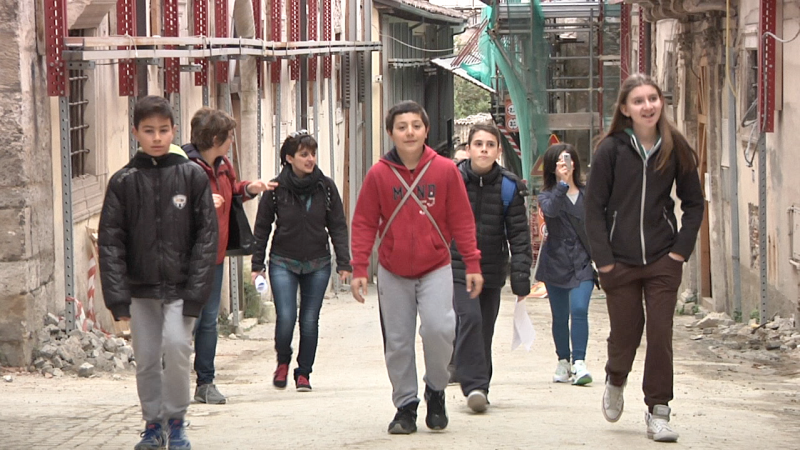
“Back to the Future” is a reportage filmed in L’Aquila in the spring of 2014, five years after the earthquake that struck and destroyed the city and several municipalities in its surrounding area, which investigates the relationship between teenagers and the city.
Reportage “Back to the future – L’Aquila five years later, what do the kids think”
“Back to the Future” is a reportage filmed in L’Aquila in the spring of 2014, five years after the earthquake that struck and destroyed the city and several municipalities in its surrounding area, which investigates the relationship between teenagers and the city.
The first part of the title contains the main meaning and significance that moved the project, Outdoor training and citizenship among preadolescents in L’Aquila , which the film documents.
After a months-long earthquake swarm, on April 6, 2009, a 6.3-magnitude (Richter scale) earthquake destroyed L’Aquila, killing 309 people, injuring more than 1,600, and displacing about 66,000.
The effects of the earthquake on social life were immediately projected on a long-lasting temporality: one year after the earthquake, only 25 percent of the population, after months spent in tent cities or accommodation facilities up to 150 kilometers away, regularly return to their homes; still in 2015, the historic center is destroyed and the suburbs partially rebuilt.
Housing policies are approached with an investment, rather than in reconstruction, in new housing developments that have profoundly disrupted urban space: around a destroyed historic center and a sprawling inhabited suburbs, 19 new settlements, arranged circularly around the city, in most cases very distant from each other and the center, as well as lacking services, have redrawn the face of a historic and artistic city in central Italy, traditionally organized and “aggregated” from its historic center .
The trauma of the earthquake, but also the housing policies, on which the shadow of the shock economy falls, the deterioration of the quality of social life, have altogether led to situations of social and psychological stress and distress, recorded by numerous studies of different disciplinary approaches.
Thinking about the future, for the new generations, who experience an altered and distant relationship with urban spaces, especially those in the historic center, which have traditionally worked as identity anchors for L’Aquila’s citizens, inevitably means returning to abandoned places, rediscovering a collective memory now diluted only in adult discourse, orienting themselves in a space they no longer recognize as their own.
Girls and boys aged 12-13 are brought back to the historic center, experience disorientation (“Do we have to go to the Villa?” asks a young student to her teacher, who replies, “we are at the Villa!”). The second part of the title raises another question: what do the children think about it?
Beyond the pre-constituted answers that the adult world formulates by replacing their voice, the children’s own “thinking” within the situation, the urban scene from which they have been substantially removed has been stimulated: the historic center, its rubble, its difficult and slow reconstruction.
What future is therefore imaginable without a return to the places of the past? The reportage documents the action-research work that the secondary school “Mazzini-Patini” and a group of scholars from pedagogical, geographical, motor and sports areas (University of L’Aquila and Polytechnic University of Madrid) conducted to analyze the situation and simultaneously to intervene on it.
It involved building a model of intervention in the post-emergency that calls into question the children’s reflexive skills, spatial skills, and the use of the body for the reappropriation of urban spaces and the search for those individual and social energies useful for discovering a sense of citizenship in a post-emergency reality.
Direction and editing: Luca Cococcetta
Concept and scientific support: Alessandro Vaccarelli
We thank:
The “Mazzini – Patini” Comprehensive Institute of L’Aquila Antonio Lattanzi, Headmaster Massimo Cococcetta. former Headmaster The teachers of II D of the Mazzini Middle School
The protagonists, the students of II D:
Asia, Fabiola, Angelo, Francesco, Giovanni, Eleonora, Federica, Serena, Andrea, Lorenzo F., Lorenzo G:, Sara L., Giulio, Marta, Claudia, Mauro, Roberta, Sara S., Giorgio, Lorenzo T., Enrico, Jessica, Anna Laura
The Cultural Association “Territories” of L’Aquila The “Danilo Dolci Center for Creative Development” and in particular Amico Dolci for the valuable stimuli on methodologies on RMA Sonia Pagnanelli for the photographs.

